
Whenever there’s a big storm in the American West, pilots probably fly into the eye, seeding clouds with a substance called silver iodide. The goal is to increase precipitation.
Cloud seeding has been around since the 1940s. It has become more widespread lately as the West battles a drought of historic proportions. States, utility companies, and even ski resorts foot the bill.
investment related news


Although it has been believed to be effective for decades, recent studies have helped prove that cloud seeding works, and there is no evidence that silver iodide is harmful at levels current. Experts say that cloud seeding typically gives a 5-15% increase in precipitation.
It is not a cure for drought, but cloud seeding can be an important water management tool.
“We can’t cause a storm and we can’t create ideal conditions in that storm. Those are natural occurrences,” said Jason Carkeet, a utility analyst and hydrologist at the Turlock Irrigation District in central Washington. California. Turlock started its cloud seeding program in 1990.
“What we’re doing is just taking advantage of existing conditions, natural conditions, and trying to make the storm more efficient again from a water supply perspective,” Carkeet said.
How Cloud Seeding Works
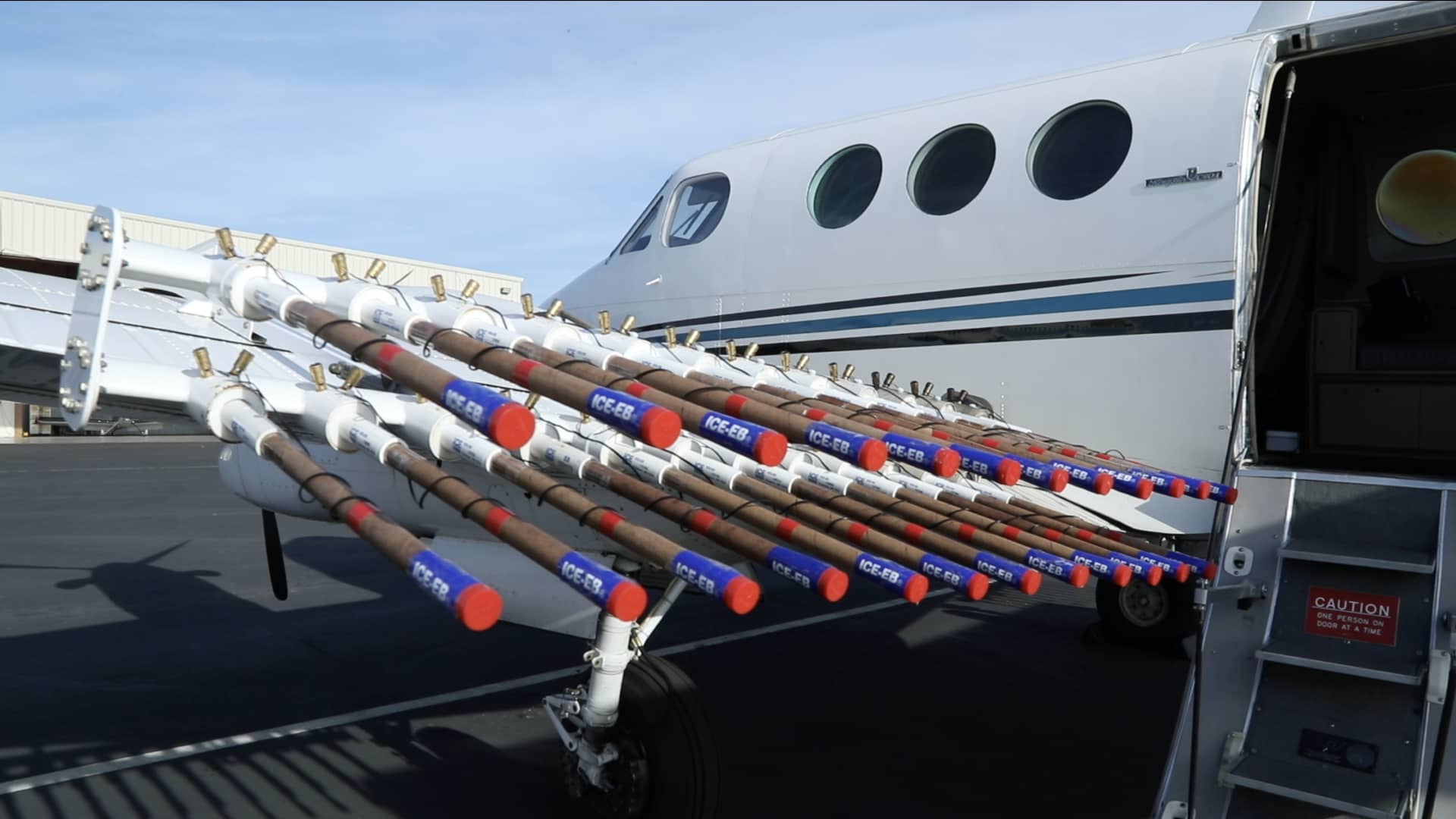
When performed by air, cloud seeding involves loading an aircraft with silver iodide. Flares are placed on the wings and fuselage.
The pilot reaches a certain altitude, where the temperatures are ideal, and fires flares into the clouds. The silver iodide causes the individual water droplets in the clouds to freeze, forming snowflakes that eventually become so heavy that they fall.
Absent the freezing process, the droplets would not bind together and would become large enough to precipitate as rain or snow.
“Initially, the cloud is just water,” said Bruce Boe, vice president of meteorology at Weather Modification International, a private company that has provided cloud seeding services since 1961. Eventually, as it makes its way to the top of the mountain, it may be 50% ice or maybe more than that, but even if it is, there’s still a lot of liquid water there. .”
Boe said there was a “window of opportunity” for the rainfall to be significant enough to fall “before it hits the mountain crest and begins to descend and warm up.”
Pilot Joel Zimmer, who works for Weather Modification International, attaches silver iodide flares to the bottom of a cloud seeding plane.
Katie Brigham | @CNBC
For cloud seeding pilots like Joel Zimmer, who works with Weather Modification International to seed clouds for the Turlock Irrigation District, flying in the storm can be an exhilarating yet intense experience.
“The moment the wheels are up, you’re in the clouds,” said Zimmer, whose route involves sowing high above the Sierra Nevada mountains. And we’re in the cloud for the entire mission until we do an approach to an airport and then we come out of the clouds and have a visual on the runway. You feel like a sub-commander of the navy. I see nothing.”
From a water supply perspective, it is more useful to sow clouds over the mountains, where water is essentially stored as snow until the spring runoff.
“When it’s on the plains like North Dakota, that’s always an advantage because it helps recharge soil moisture,” Boe said. “But it cannot be stored and used for a later date.”
While Texas uses cloud seeding to help irrigate farmers’ fields, it’s more common in the West, where states like Idaho, California, Colorado, Utah and Wyoming use it to help fill their rivers and reservoirs. Most programs use aircraft for cloud seeding, but some use ground flares.
“It’s a lot more common than people think,” Carkeet said. “More ponds have a stocking program than don’t.”
Costs and impact
Boe says the cost is almost always worth it.
“It makes perfect sense for water managers to go ahead and do this, even if the increase is in the order of a few percentage points,” he said.
Idaho Power spends about $4 million a year on its cloud seeding program, which results in an 11% or 12% increase in snow cover in some areas, resulting in billions of additional gallons of water at a cost about $3.50 per acre-foot. This compares to about $20 per acre-foot for other methods of accessing water, such as through a water supply bank.
And although Turlock only sees a 3% to 5% increase in runoff from its program — which has a maximum budget of $475,000 — California will take all the extra water it can get.
“That’s one of the things that makes the assessment so difficult is that you don’t see a doubling or tripling of precipitation,” Boe said. “You see a gradual increase, but you add it up over a winter and then it can be significant.”
Watch the video to learn more about what it takes to make it rain.
.
Comments
Post a Comment